Proprietary Technologies vs Open-Source: Strategy, Freedom and Dependency
 Igor Brandão#igorabrandao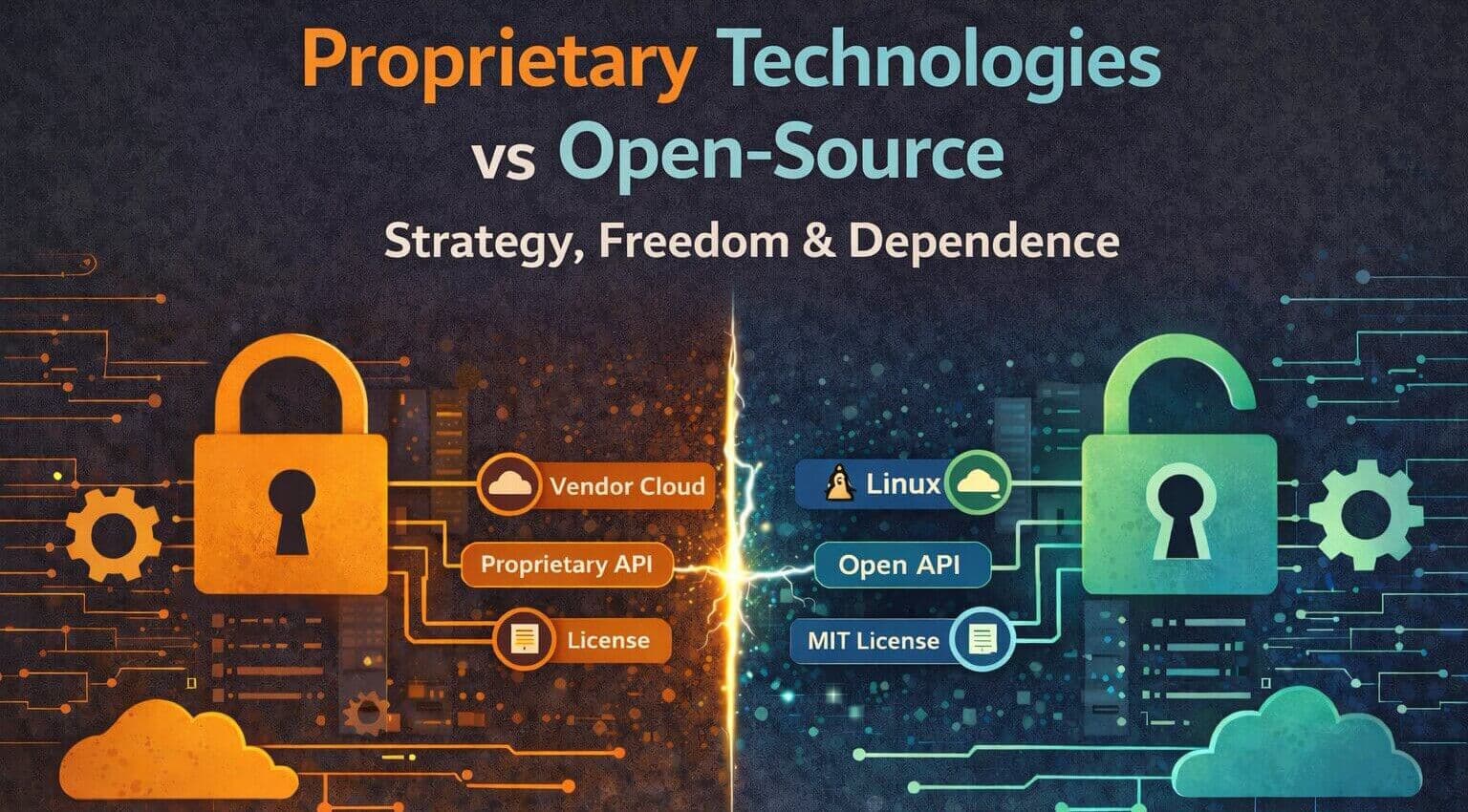
Proprietary vs Open-Source Technologies: Strategy, Freedom, and Dependency
Hello, I’m Igor Brandão, developer and founder of IBTI. Throughout my experience building systems and SaaS platforms, I’ve learned that the choice between proprietary and open-source technologies goes far beyond technical preference — it directly impacts cost, scalability, and long-term autonomy. This article comes from that practical and strategic perspective.
The debate between proprietary and open-source technologies is not ideological.
It is strategic.
This is not about “Microsoft vs Linux” or “.NET vs JavaScript.”
It’s about control, cost, scalability, and long-term autonomy.
The real question is:
Does your company control its technology — or is it controlled by it?
What Is Really at Stake?
When choosing a technology stack, we are defining:
🔒 Level of vendor dependency
💰 Future cost structure
🔐 Auditability and security capacity
🚀 Innovation speed
🧩 Freedom to evolve
Technical decisions directly impact business strategy.
Case 1 — Linux Servers vs Windows Server
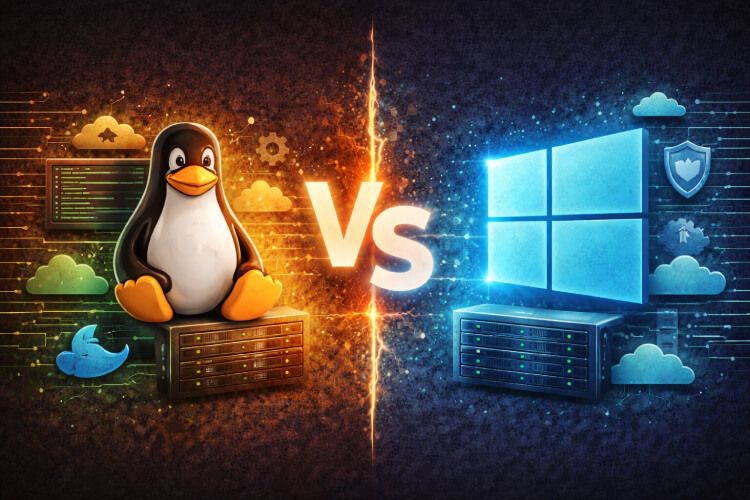
Linux (Open-Source)
Pros
No licensing cost
High stability
Dominant standard in cloud environments
Strong integration with Docker and Kubernetes
Ideal for Infrastructure as Code
Cons
Requires a skilled technical team
Steeper learning curve for non-technical environments
Windows Server (Proprietary)
Pros
Strong integration with the Microsoft ecosystem
User-friendly graphical interface
Facilitates legacy enterprise environments
Cons
Licensing per server/core
Version dependency
Less flexibility in cloud-native environments
Today, most cloud infrastructure runs on Linux.
Not ideology — market standard.
Practical Use Case
Imagine a growing SaaS startup beginning with a small cloud setup.
Initially, the company chose Windows Server because the team is already familiar with the Microsoft ecosystem. Deployment is fast and functional.
As the product grows:
Horizontal scaling becomes necessary
Containers are required
CI/CD pipelines grow more complex
Licensing costs per instance increase
Each new machine adds licensing cost.
After migrating to a Linux-based architecture:
Cost per instance decreases
Docker and Kubernetes integration becomes natural
Infrastructure as Code becomes simpler
The environment aligns with cloud-native standards
The result is not just savings.
It’s flexibility.
In scalable SaaS environments, operating system choice becomes a strategic decision — not a technical detail.
Case 2 — PostgreSQL/MySQL vs SQL Server

PostgreSQL / MySQL (Open-Source)
Pros
No licensing cost
High performance and scalability
Active community
Advanced extensibility
Easy portability
Cons
Requires technical administration
Support depends on the team or partner
SQL Server (Proprietary)
Pros
Robust integrated tools
Strong integration with .NET
Official enterprise support
Cons
Expensive per-core licensing
Scalability can become financially heavy
Ecosystem lock-in
In scalable systems, per-core licensing can become a financial bottleneck.
Practical Use Case (Industrial Company)
Imagine an industrial company modernizing its internal operational management system — inventory control, logistics, reporting, and order management.
Initially, SQL Server makes sense due to the existing Microsoft infrastructure.
Over time:
Data volume grows significantly
External integrations increase
Analytical reporting expands
Additional environments are required (staging, testing, disaster recovery)
Each new environment requires additional licenses.
Each capacity increase impacts per-core cost.
By migrating to PostgreSQL:
Licensing costs are eliminated
Environments can be replicated freely
Cloud portability improves
Full control over the data structure is maintained
The shift is not just technical.
It allows the IT budget to focus on innovation rather than on maintaining licenses.
Case 3 — React / TypeScript / JavaScript vs .NET
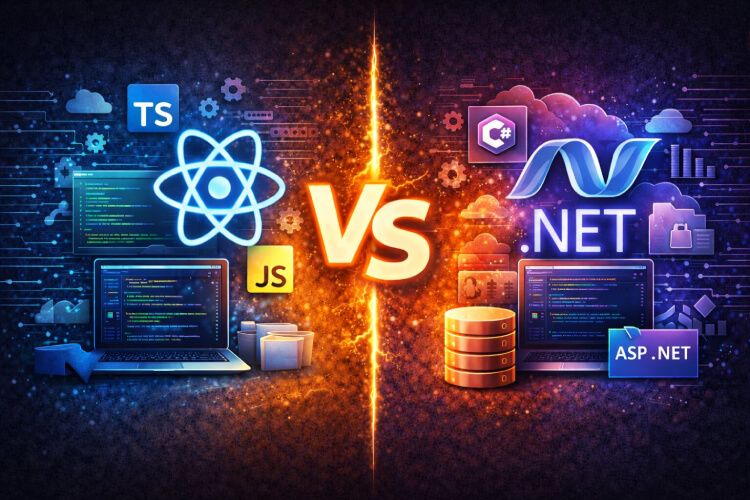
Open Ecosystem (React / Node / TypeScript)
Pros
Massive community
Rapid evolution
High architectural flexibility
Multi-cloud friendly
Industry standard in startups and SaaS
Cons
Requires architectural discipline
Standards can vary without governance
.NET Ecosystem
Pros
Strong standardization
Mature tooling
High productivity for Microsoft-oriented teams
Cons
Strong ecosystem dependency
Less diversity outside the Microsoft environment
This is not about quality.
It’s about the level of dependency and future flexibility.
Practical Use Case — Educational App
A company builds a multi-platform application (web + mobile), including:
Authentication
Video streaming
Real-time chat
Push notifications
Admin panel
Payment and third-party API integrations
The app must handle gradual growth and seasonal spikes.
Scenario 1 — .NET + Windows Server
Architecture:
ASP.NET backend
SQL Server
Windows Server hosting
Azure ecosystem integration
Infrastructure:
2 Windows VMs (App + API)
1 SQL Server instance
Windows Server licensing
SQL Server per-core licensing
As the app scales:
More instances → more licenses
More cores → more cost
Horizontal scaling increases proportional licensing expense
Deployment:
Azure DevOps
Often Azure-centric services
Potential vendor lock-in
Scenario 2 — Open Stack (React + Node + PostgreSQL + Linux)
Architecture:
React + TypeScript frontend
Node.js backend
PostgreSQL
Linux infrastructure
Docker containers
Kubernetes orchestration
Infrastructure:
2 Linux VMs
1 PostgreSQL instance
No OS license cost
No database license cost
Scaling:
Add containers
Add Kubernetes nodes
Pay only for compute and storage
Over 3–5 years of growth, accumulated cost differences can be substantial.
Deployment & DevOps
OpenStack enables:
Infrastructure as Code (Terraform)
CI/CD with GitHub Actions or GitLab
True multi-cloud portability
Container portability
Proprietary stacks tend to:
Centralize pipelines within the vendor ecosystem
Encourage vendor-specific services
Developer Availability
The JavaScript/TypeScript ecosystem has the largest global developer base
(Source: Stack Overflow Developer Survey 2025)
React dominates web frontend.
Node.js is widely adopted.
Availability affects hiring cost and team scalability.
Case 4 — Custom Development with AI vs Low-Code (Mendix and similar)
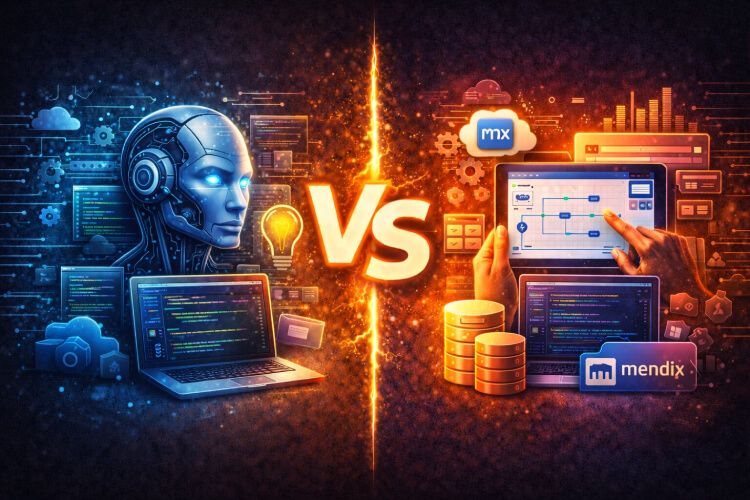
Low-Code Platforms (Proprietary)
Pros
Fast initial delivery
Lower initial technical demand
Rapid prototyping
Cons
Severe lock-in
Architectural limitations
Vendor-controlled scalability
Growing costs
Limited deep customization
Custom Development + AI (Open Stack)
Pros
Full architectural control
True scalability
No structural lock-in
Complete technical governance
AI dramatically reduces development time
Cons
Requires a skilled technical team
Higher architectural responsibility
AI has significantly reduced the historical speed advantage of low-code.
Today, it’s possible to move fast without sacrificing control.
Real Experience
In a real project I followed, a client initially chose a low-code platform (Mendix) to accelerate internal application development.
At first:
Fast delivery cycles
Visual interface
Reduced need for specialized engineering
But as systems evolved and became business-critical:
Structured debugging became difficult
Log visibility and monitoring were limited
Performance bottlenecks were harder to diagnose
Advanced custom flows were restricted
Deep integrations were constrained
As the system became core to the business, the lack of technical control created operational risk.
With AI reducing custom development time, the client made a strategic decision to rebuild key systems using open-stack custom architecture with AI-assisted development.
The result:
Full log control
Deep debugging capability
Complex rule customization
Modular and scalable architecture
Reduced technological lock-in
The decision was not ideological.
It was strategic.
When systems become core to the business, control outweighs initial speed.
Case 5 — Open-Source Infrastructure (Linux / OpenStack) vs Google Cloud / Amazon Web Services (AWS)
Infrastructure is one of the most structural decisions any digital company makes.
We are not simply comparing providers here.
We are comparing control models.
🔹 Open-Source Infrastructure (Linux + OpenStack)
What it is
Linux servers
Self-managed virtualization
OpenStack for orchestration
Full control over networking, storage, and compute
Can run on-premise or in a contracted data center
Pros
✔ Full architectural control
✔ No vendor-specific lock-in
✔ Deep customization of networking and security
✔ Predictable costs after initial investment
✔ Ideal for regulatory environments and data sovereignty
Cons
✖ High initial investment (CAPEX)
✖ Requires a specialized infrastructure team
✖ Full responsibility for security and availability
✖ Scalability limited by installed physical capacity
🔹 Google Cloud / Amazon Web Services (AWS)
What it is
Infrastructure as a Service (IaaS) and Platform as a Service (PaaS), including:
On-demand compute
Managed databases
Elastic storage
AI services
Serverless services
Global CDN
Pros
✔ Instant scalability
✔ Automatic elasticity
✔ Managed services
✔ Strong SLA
✔ Simplified global expansion
Cons
✖ Structural vendor dependency
✖ Variable and sometimes unpredictable costs
✖ Increasing billing complexity
✖ Strong lock-in through proprietary services (Lambda, BigQuery, DynamoDB, etc.)
Practical Use Case — Real Experience with AWS vs Open-Source Infrastructure
In a real project I was involved in, a robotics technology company maintained a proprietary Linux package repository (PPA).
The business model required:
Frequent build generation
Compilation for multiple Linux distributions
Architecture variations (x86_64, ARM)
Automated CI/CD build pipelines
Continuous versioning
The strategy adopted was to use AWS to:
Provision on-demand instances
Run build pipelines
Store artifacts
Distribute packages
Initially, the solution made sense:
✔ Fast provisioning
✔ Automatic scalability
✔ Seamless pipeline integration
✔ No need for internal infrastructure
The problem emerged at scale
As the product grew:
The number of daily builds increased dramatically
Frequent releases required full recompilation
Parallel builds were automatically triggered
Testing and validation consumed intensive computing resources
The billing model is based on:
Instance time
CPU usage
Temporary storage
Data transfer
began scaling alongside operations.
The result
The monthly AWS bill exceeded $100,000 solely for build generation.
Important clarification:
This was not production infrastructure.
It was not customer-facing.
It was exclusively for the build pipeline.
The cost was directly tied to the on-demand elasticity billing model.
Technical review
After reviewing the architecture, it became clear that:
The workload was highly predictable
Build volume was constant
The workload was repetitive and automated
It did not require global elasticity
In other words:
It was an ideal case for dedicated infrastructure.
Open Infrastructure Alternative (Linux + OpenStack)
An architecture based on:
Dedicated Linux cluster
OpenStack for internal provisioning
Dedicated build nodes
Orchestration via Kubernetes or dedicated runners
Internal artifact storage
would enable:
✔ Predictable fixed costs
✔ Elimination of per-minute CPU billing
✔ Maximum utilization of provisioned hardware
✔ Independence from variable billing models
The initial investment (CAPEX) would be higher.
However, recurring operational costs could drop significantly — and in some scenarios, the marginal cost per build could approach zero after infrastructure amortization.
The Strategic Lesson
Cloud is excellent for:
Unpredictable workloads
Early-stage growth
MVP development
True elastic scaling
But not every workload requires infinite elasticity.
Predictable, compute-intensive workloads can become financially inefficient under purely elastic pricing models.
The Core Point
The problem was not AWS.
The issue was misalignment between:
The billing model
and
The workload model
Technology must serve strategy.
When variable costs begin scaling disproportionately relative to generated value, it is a clear sign that the architecture needs to be reassessed.
Vendor Lock-In: The Silent Risk
Vendor lock-in is not an immediate technical problem.
It is a structural risk that emerges over time.
It happens when architecture, data, and processes become dependent on vendor-exclusive characteristics.
Exclusive APIs
Vendor-specific APIs and SDKs:
Have no direct equivalent elsewhere
Require specific integration formats
Depend on internal authentication flows
Short-term acceleration, long-term dependency.
Limited Data Export
Migration is not just copying data.
It requires preserving:
Integrity
Relationships
Indexes (primary, secondary, composite, unique, full-text)
Constraints
Triggers
History
If formats are controlled by the vendor, autonomy is reduced.
Migration Costs
Lock-in appears as:
Rewriting cost
Infrastructure restructuring
Pipeline reconfiguration
Team retraining
Operational risk
Companies often stay because it’s not ideal, but because leaving is more expensive.
Roadmap Dependency
With proprietary systems:
Vendor defines roadmap
Vendor controls updates
Innovation is limited by external priorities
Technology should expand strategic freedom — not restrict it.
Security: Myth or Advantage?
Closed source does not mean more secure.
Open-source allows:
Public audit
Faster community fixes
Full transparency
Security depends more on governance than licensing.
When Proprietary Makes Sense
It can make sense when:
No internal technical team
SLA outsourcing is critical
Legacy integration is dominant
Product development is not the focus
Context matters.
When Open-Source Is Strategic
Open-source tends to be advantageous when:
Building SaaS
Scaling globally
Seeking technological independence
Operating in regulated environments
Requiring rapid evolution
Here, autonomy becomes a competitive advantage.
Where IBTI Stands
At IBTI, we prioritize open-source technologies because we believe in:
Technological autonomy
Auditability
Sustainable scalability
Architectural freedom
It’s not ideology.
It’s a long-term strategy.
As a developer, I prefer building systems that clients truly own — not merely rent under restrictive contracts.
Conclusion
The choice between proprietary and open-source is not purely technical.
It is strategic.
The question is not which is “better.”
It is:
Are you buying short-term convenience — or building long-term independence?
Technology should serve your business.
Never imprison it.
🚀 Build Technology with Freedom and Long-Term Vision
Choosing the right stack is not just a technical decision — it’s strategic.
At IBTI, we build systems using modern architectures, open-source stacks and strong engineering practices to ensure:
Technological autonomy
Sustainable scalability
Reduced lock-in
Governance and security
Continuous product evolution
If you want to build or modernize your software with independence, performance, and real growth in mind:
👉 Learn more about our software development services:
https://ibti.tech/en/services/software-development/
Technology should empower your business — not limit it.
Igor Brandão
#igorabrandao🇧🇷 Português
Olá! Sou o Igor, analista de sistemas com mais de 10 anos de experiência em desenvolvimento de software. Tenho formação em Análise de Sistemas, TI e Administração, além de um Mestrado em Bioinformática. Apaixonado por criar soluções inteligentes e eficientes.
🇺🇸 English
Hello! I’m Igor, a systems analyst with over 10 years of experience in software development. I hold degrees in Systems Analysis, IT, and Business Administration, along with a Master’s in Bioinformatics. Passionate about building smart, efficient solutions.